In this sample of 4,179 public comments under Facebook and Instagram ads, from about 21 business ad accounts in the US, Australia and New Zealand, and the UK and Europe, 159 (about 3.8%) were negative. Price questions were mostly leads, not complaints, and Meta’s API did not return every comment it counted.
Go deeper: every statistic with its sample size, how we collected and classified the data, and the comments Meta counts but doesn’t return.
Key findings
- In this sample, 159 of 4,179 comments (about 3.8%) were negative by our current rules. Most comments under ads were not negative, so blunt tactics like hiding everything throw away good comments.
- Price questions are leads. An older version of our rules hid 27 comments that our current rules keep, mostly “How much?”.
- Arrival times show a directional pattern. In Australia and New Zealand, both all comments and negatives peaked in the evening, 18:00 to 22:00 Sydney time, strongest around 19:00. The samples are small, so treat timing as a guide, not a rule.
- Meta doesn’t return every comment. In one full sweep on 8 October 2026, Meta counted 206 comments across the ads in the sample that its API did not return.
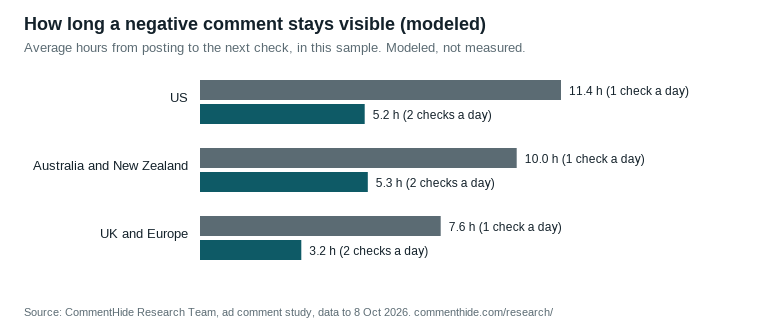
- Checking twice a day roughly halves exposure (modeled). Our model estimates that moving from one check a day to two cuts the average time a negative comment stays visible from about 10 hours to about 5 hours.
The data
We gathered every comment with a timestamp from our moderation logs and full comment sweeps, across about 21 ad accounts in three regions: the US, Australia and New Zealand, and the UK and Europe. After removing duplicates there were 4,685 comments. We then removed the businesses’ own replies, leaving 4,179 comments from the public. They range from August 2023 to 8 October 2026, mostly 2026. All client names and commenter details are removed here. The full method is on the methodology page.
What counts as negative
A comment counted as negative if our current classifier marks it as a clear negative or an edge negative, or if it had already been hidden or deleted and its text was no longer available to re-check. Typical examples, paraphrased: “bait and switch”, “it’s not free”, “scam, they make you pay a deposit”, “don’t fall for it, they pressure you to buy”, plus general trolling and profanity.
Negative comments by region
| Region | Negative comments | All comments |
|---|---|---|
| US | 89 | 2,826 |
| Australia and New Zealand | 62 | 1,144 |
| UK and Europe | 8 | 209 |
The UK and Europe sample is small, so treat its patterns with caution.
When negative comments arrive
- US (New York time): negatives were spread through the day, with the most between 10:00 and 16:00. All comments built through midday and again in the evening.
- Australia and New Zealand (Sydney time): negatives and all comments both peaked 18:00 to 22:00, with the single biggest hour for negatives at 19:00.
- UK and Europe (London time): comments clustered between 14:00 and 20:00.
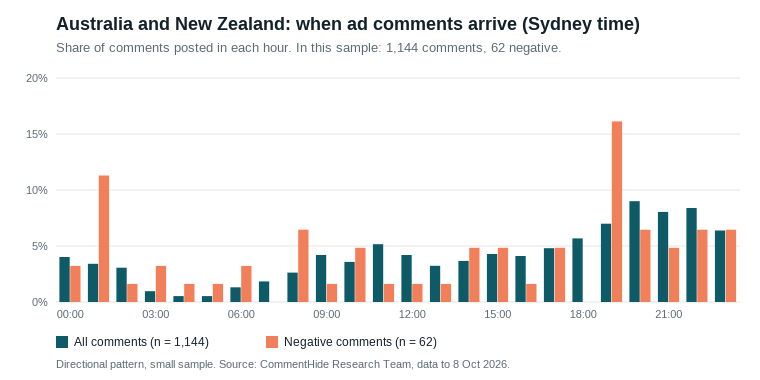
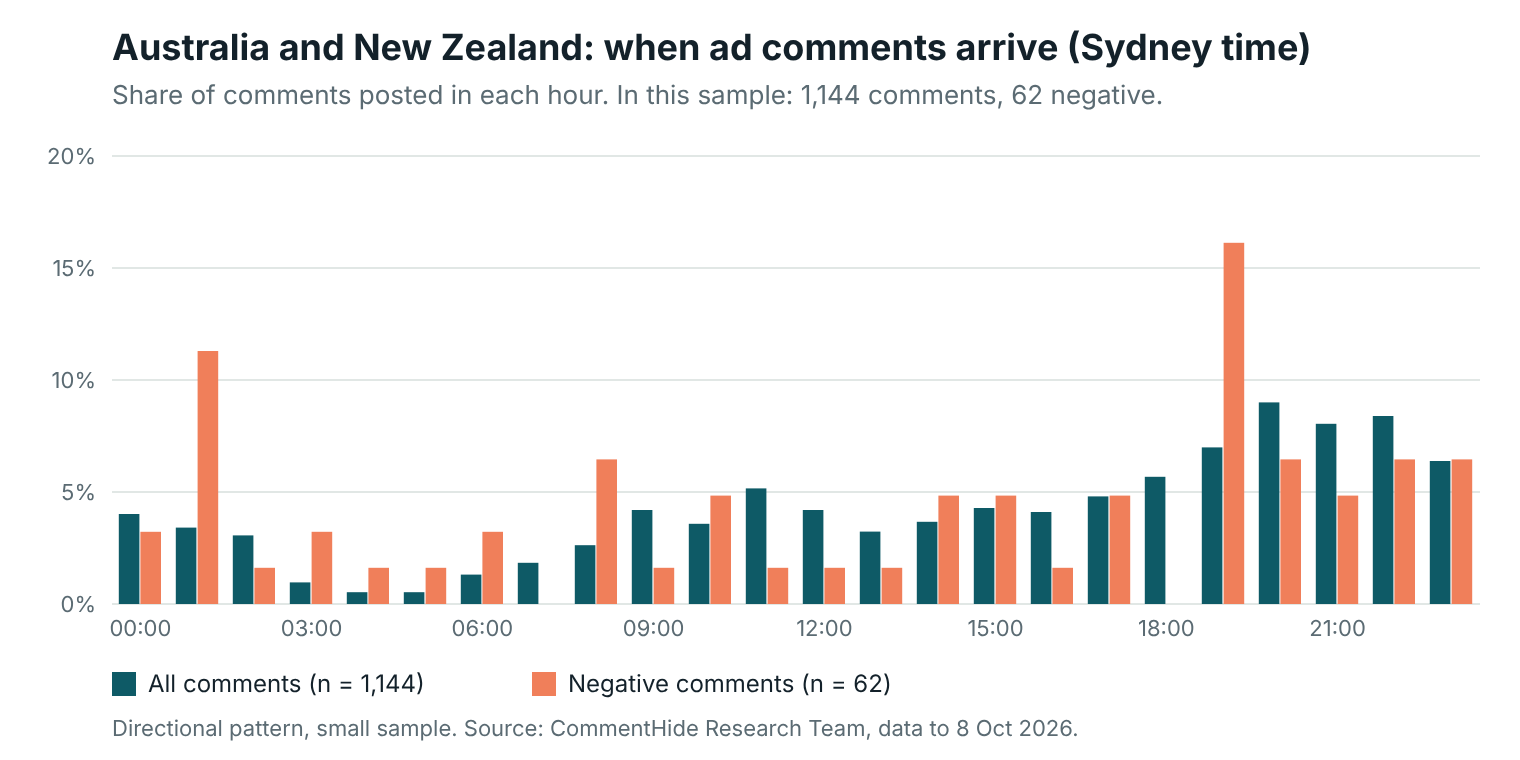
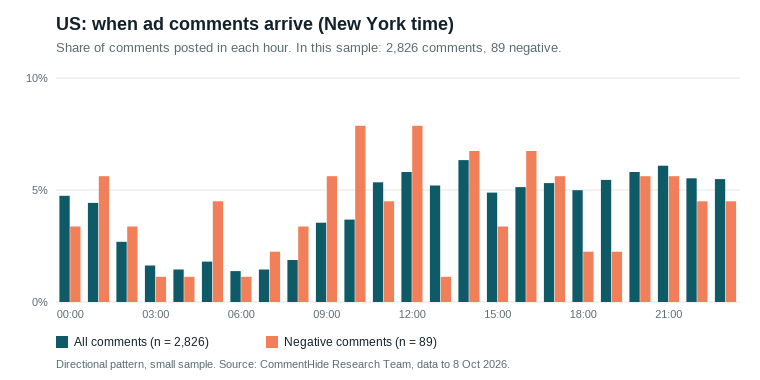
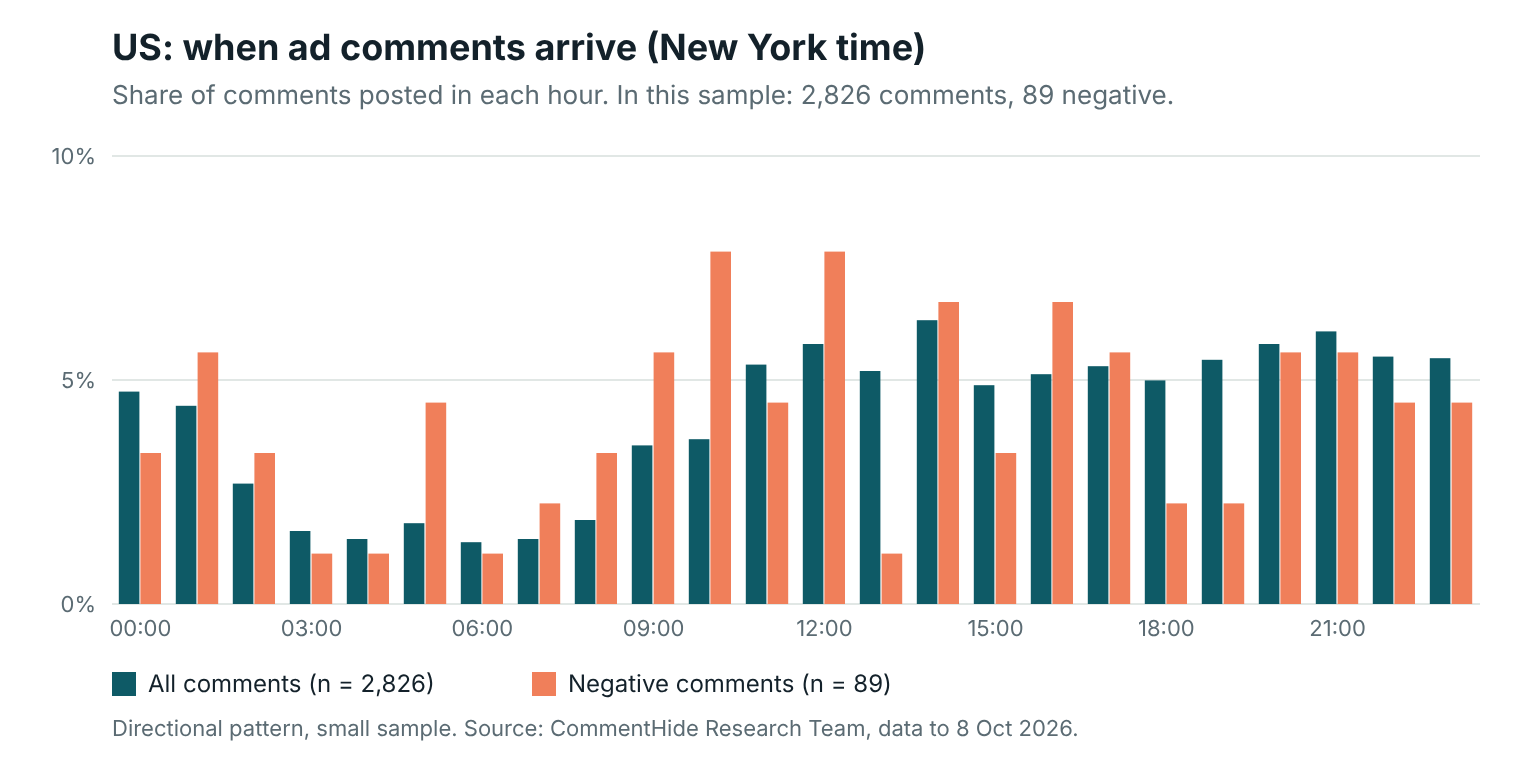
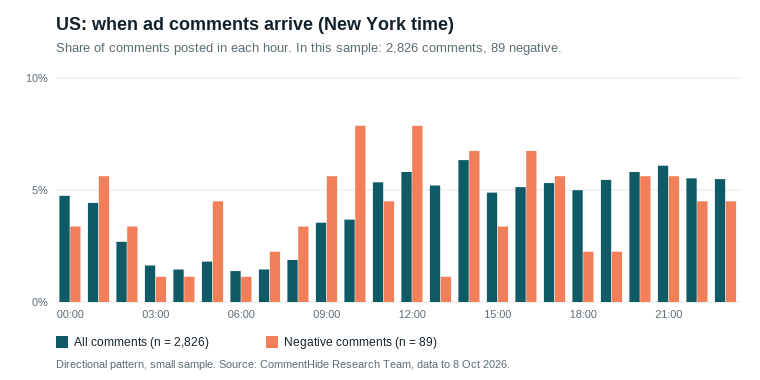
We used these directional patterns to pick check times that land just after each region’s busiest period.
How long negatives stay visible
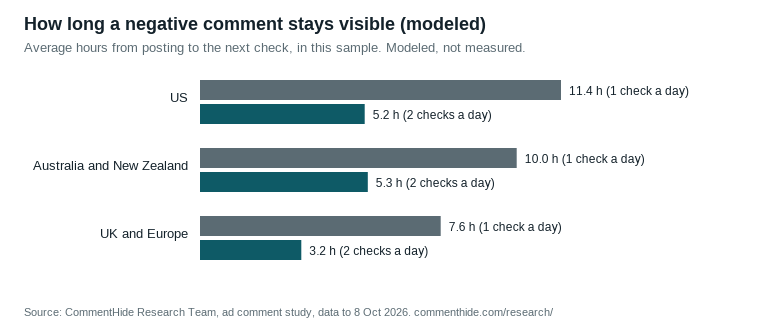
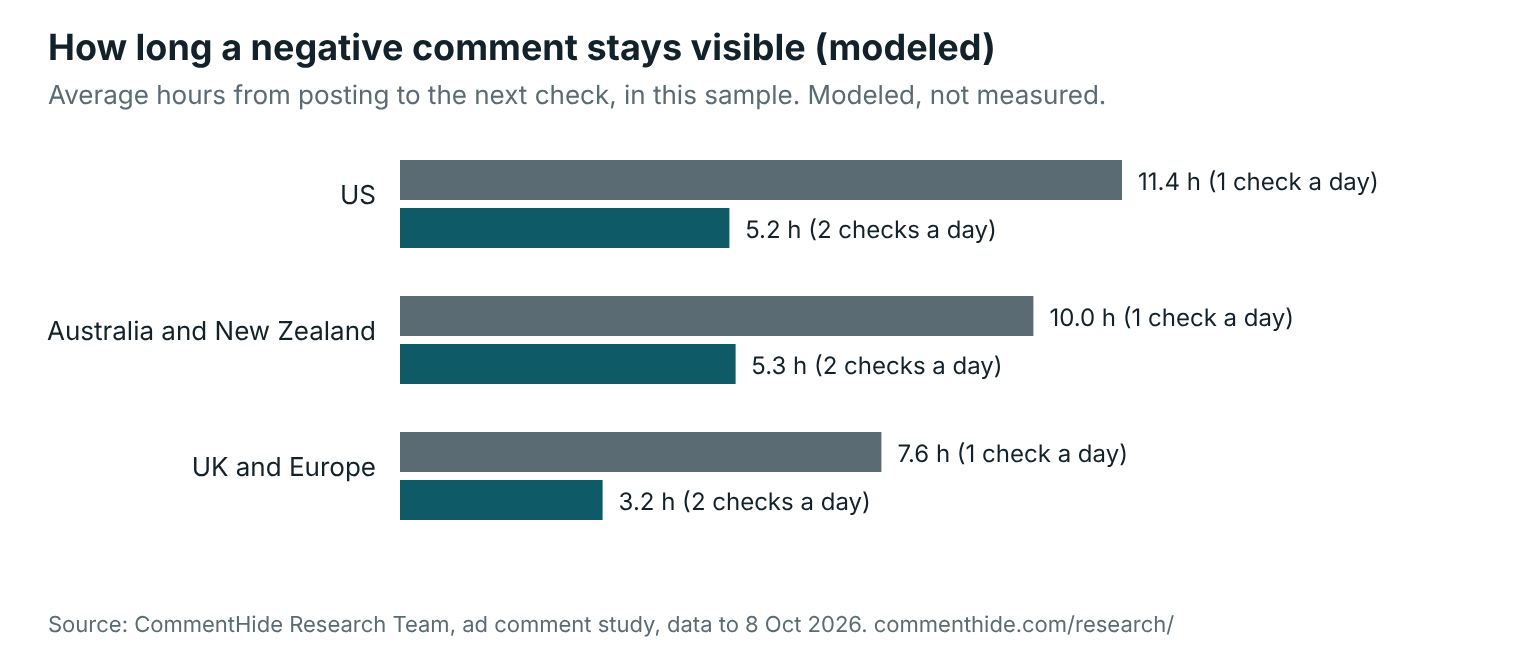
Using the arrival times above, we modeled the average time between a negative comment being posted and the next scheduled check. These are modeled figures, not measured ones:
| Region | 1 check a day | 2 well-timed checks a day |
|---|---|---|
| US | 11.4 hours | 5.2 hours |
| Australia and New Zealand | 10.0 hours | 5.3 hours |
| UK and Europe | 7.6 hours | 3.2 hours |
Comments Meta won’t show
On many posts, Meta’s comment count is higher than the number of comments its API returns. On 8 October 2026 that gap was 206 comments across all ads in the sample. Instagram’s help center says hidden comments still count toward a post’s total, and we think restricted accounts and Meta’s own filtering also play a part. No tool that works through Meta’s API can moderate comments the API doesn’t return, so we check these posts by hand. More in the Meta API comment gap.
Lessons that shaped our rules
- Hide by default. An early rule misread friendly comments like “What about cat dads?” under an ad aimed at moms, and deleted four of them. Deletion can’t be undone, so hiding is now the default, deleting only happens if you switch it on, and friendly questions like that are kept.
- “Complimentary” cuts both ways. “I’d love a complimentary session” is a lead. “Complimentary means you pay $1000 later” is snark. The rules tell them apart.
- Phones type curly apostrophes. “Don’t” and “Don’t” must match the same rule.
- Word forms matter. A rule for “pressure” must also catch “pressured”.
- Broad words misfire. “Catch” alone matched “catch you later”, so the rule became “what’s the catch”.
Limitations
- Most comments come from offer-style lead ads for local service businesses, so other industries and ad types may differ.
- Many timed comments are older comments on long-running ads, not just new arrivals.
- The UK and Europe sample has only 8 negatives.
- Comments were classified by our own rules, not by an independent panel.
- Exposure times are modeled, not measured.
Download the data
The aggregated CSV has region totals, hourly counts on each region’s local clock and the modeled exposure figures. It has no comment text, no commenter details and no account names. The columns are explained in the data dictionary, and the charts can be embedded from the statistics page.
Cite this: CommentHide Research Team. “What 4,179 real ad comments tell us about negative comments on Meta ads.” CommentHide, updated 24 October 2026. https://commenthide.com/research/ad-comment-study/
Please say the figures come from this sample of 4,179 comments under Facebook and Instagram ads, and link to this page.
Frequently asked questions
What percentage of comments on Facebook ads are negative?
In this sample, 159 of 4,179 public comments under Facebook and Instagram ads, about 3.8%, were negative. That is one sample from about 21 business ad accounts, mostly offer-style lead ads, so other industries and ad types may differ.
Should I hide every comment on my ads?
This sample suggests not. Most comments were not negative, and an older version of our rules hid 27 comments that our current rules keep, mostly price questions such as “How much?”. Hiding everything would hide those buying questions too.
How often should ad comments be checked?
Our model suggests two well-timed checks a day roughly halve the average time a negative comment stays visible compared with one check a day. In the US part of this sample, that was 11.4 hours down to 5.2 hours. These figures are modeled, not measured.
Can I use this data?
Yes. You can cite the study and download the aggregated counts as a CSV file. Please credit the CommentHide Research Team, link to this page and say the figures come from this sample. The download has counts only, with no comment text or account names.
Related: how CommentHide works, how to hide comments on Facebook ads.
Want your ad comments cleaned up automatically? Connect your Facebook and Instagram ad accounts and the first scan runs straight away.