These statistics come from one sample: 4,179 public comments under Facebook and Instagram ads from about 21 business ad accounts, collected to 8 October 2026. In this sample, 159 comments (about 3.8%) were negative. Each figure below is one dated sentence with its sample size, so you can quote it accurately.
The full write-up is the ad comment study. How the data was collected and classified is on the methodology page.
Ad comment statistics, in this sample
- In this sample of 4,179 public comments under Facebook and Instagram ads, collected to 8 October 2026, 159 (about 3.8%) were negative.
- In this sample, 4,685 unique comments were collected, and 506 of them were the advertisers’ own replies, which were removed before analysis (data to 8 October 2026).
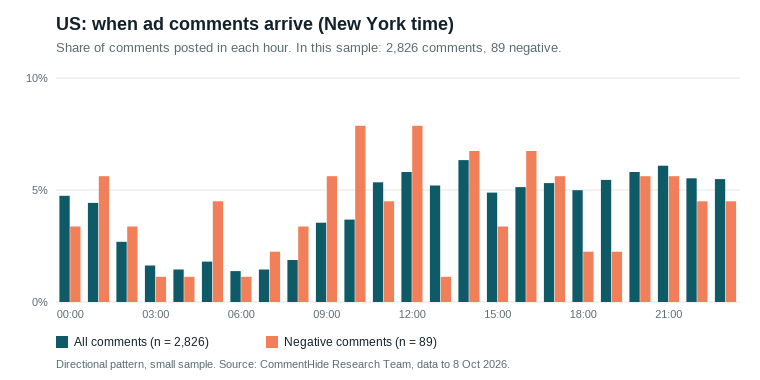
- In the US part of this sample, 89 of 2,826 comments (about 3.1%) were negative (data to 8 October 2026).
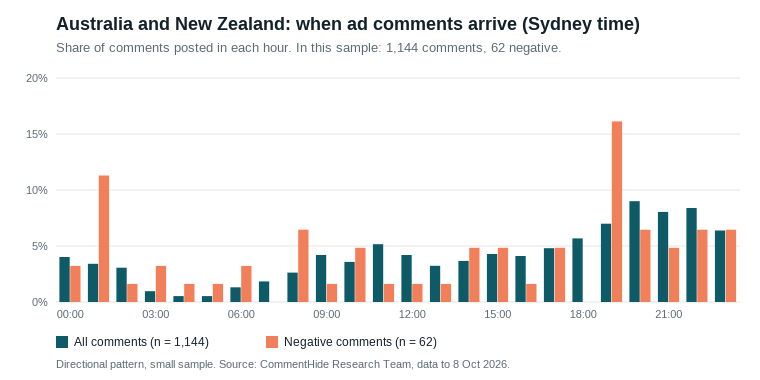
- In the Australia and New Zealand part of this sample, 62 of 1,144 comments (about 5.4%) were negative (data to 8 October 2026).
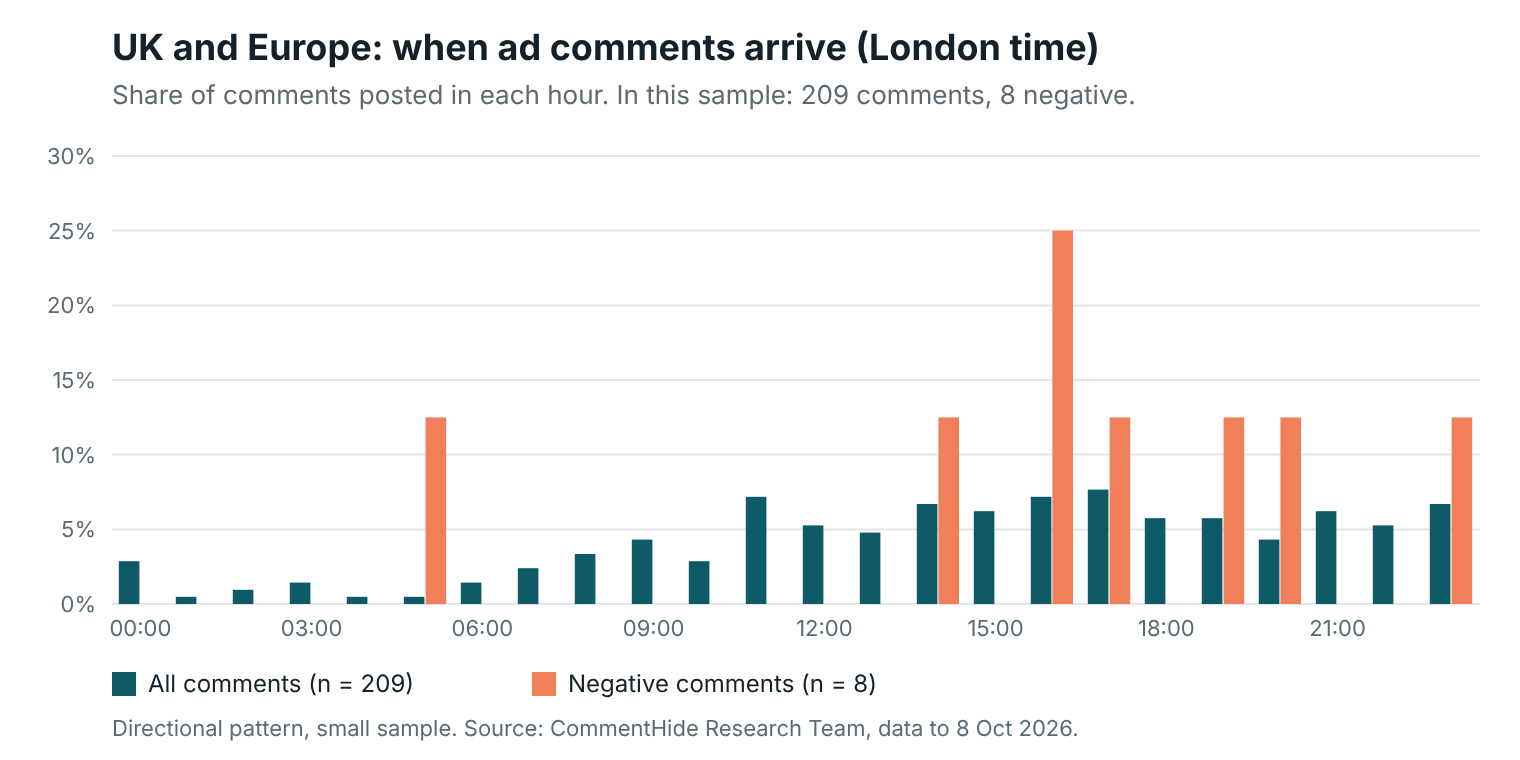
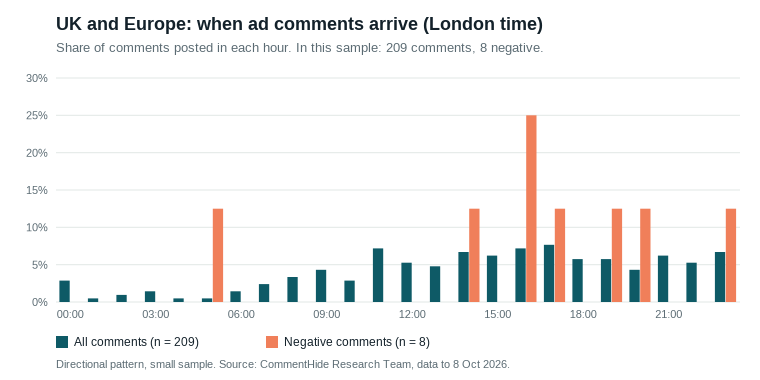
- In the UK and Europe part of this sample, 8 of 209 comments were negative, too few to draw firm conclusions (data to 8 October 2026).
- In the US part of this sample, two ad accounts on the Pacific coast accounted for 60 of the 89 negative comments (data to 8 October 2026).
- In this sample, an older version of CommentHide’s rules hid 27 comments that the current rules keep, mostly price questions such as “How much?” (4,179 comments, data to 8 October 2026).
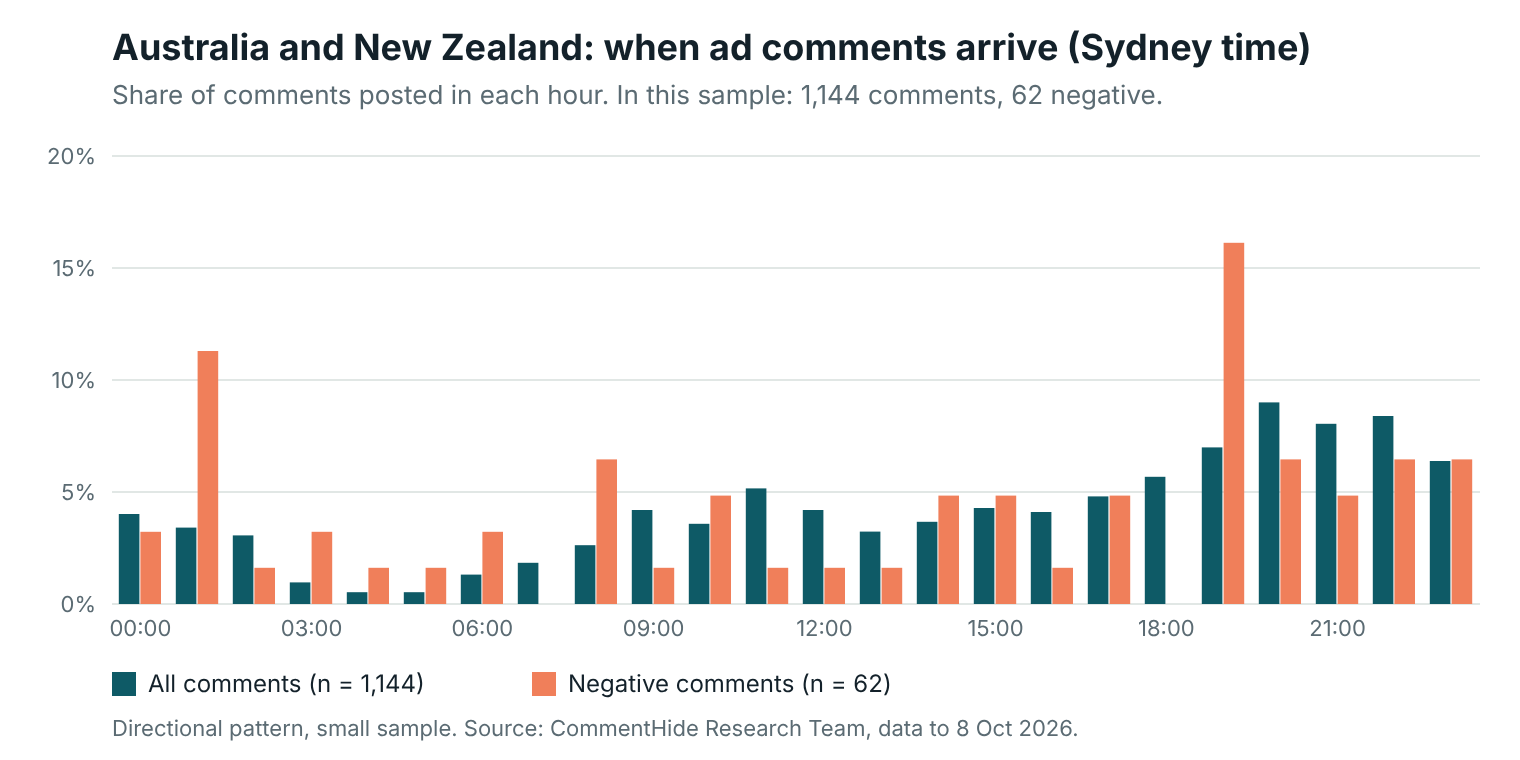
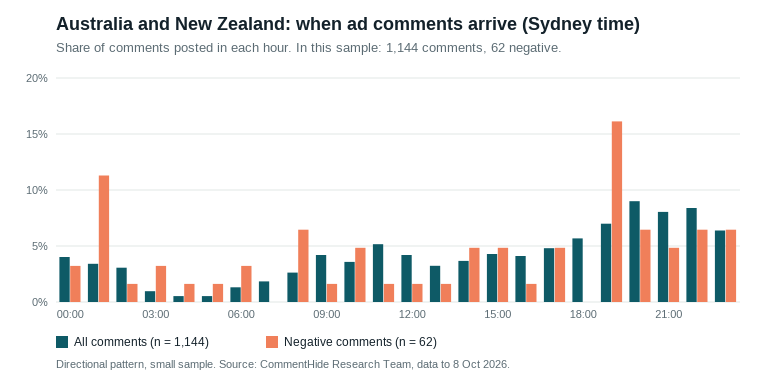
- In the Australia and New Zealand part of this sample, all comments peaked between 18:00 and 22:00 Sydney time, and the busiest hour for negative comments was 19:00, with 10 of 62 (data to 8 October 2026).
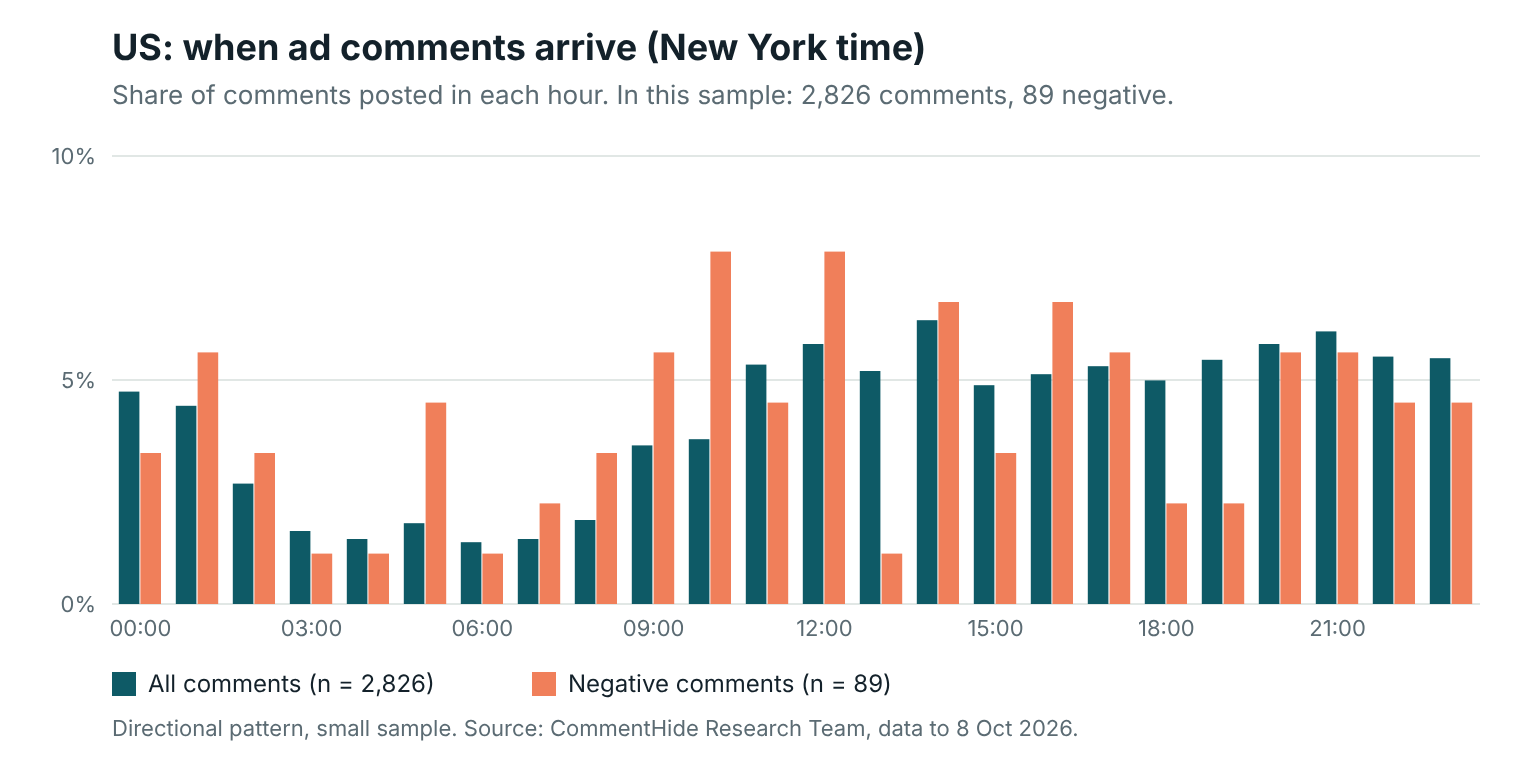
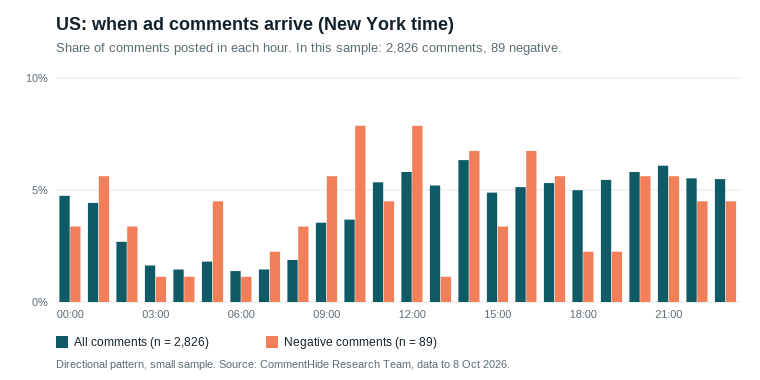
- In the US part of this sample, the busiest hours for negative comments on New York time were 10:00 and 12:00, with 7 each, followed by 14:00 and 16:00, with 6 each, out of 89 (data to 8 October 2026).
- In the US part of this sample, the busiest hours for all comments on New York time were 14:00, with 179, and 21:00, with 172, out of 2,826 (data to 8 October 2026).
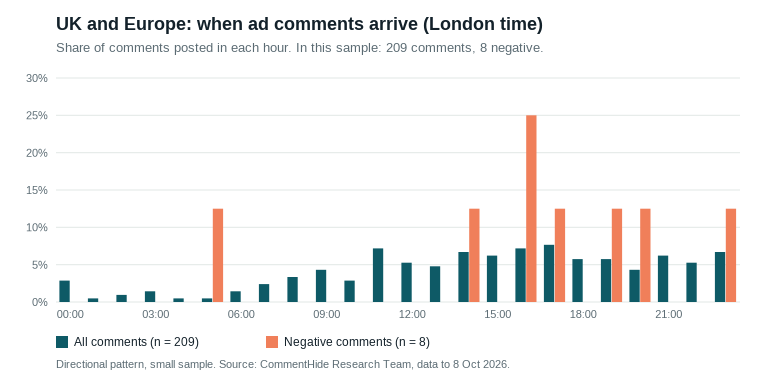
- In the UK and Europe part of this sample, comments clustered between 14:00 and 20:00 London time, with a smaller bump at 23:00 (209 comments, data to 8 October 2026).
- In one full sweep on 8 October 2026, Meta’s comment counts for the ads in this sample were 206 higher than the number of comments its API returned, and one account accounted for 92 of them.
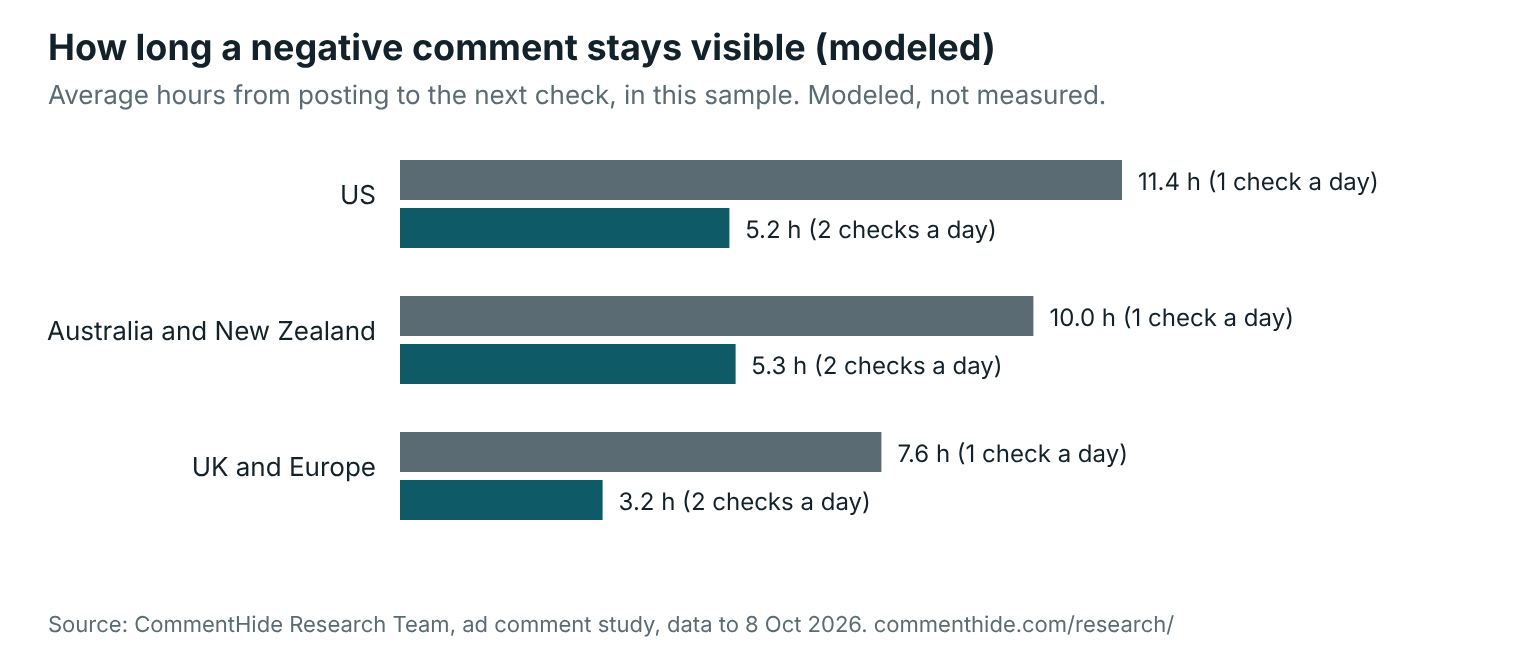
- In this sample, our model estimates that two well-timed checks a day instead of one would cut the average time a negative comment stays visible from 11.4 to 5.2 hours in the US, 10.0 to 5.3 hours in Australia and New Zealand, and 7.6 to 3.2 hours in the UK and Europe (modeled, not measured; data to 8 October 2026).
- The comments in this sample were posted between August 2023 and 8 October 2026, mostly in 2026.
Percentages by region are 89 of 2,826, 62 of 1,144 and 8 of 209, rounded to one decimal place. They describe this sample only, not all Facebook or Instagram ads.
Comments by region
| Region (clock used) | All comments | Negative comments | Share negative |
|---|---|---|---|
| US (New York) | 2,826 | 89 | about 3.1% |
| Australia and New Zealand (Sydney) | 1,144 | 62 | about 5.4% |
| UK and Europe (London) | 209 | 8 | about 3.8% |
| Total | 4,179 | 159 | about 3.8% |
When comments arrive, by hour
These charts show each hour’s share of all comments and of negative comments, on each region’s local clock. Hour-of-day patterns are directional: the samples are small and many comments are older comments on long-running ads.
Download and embed
- Download the aggregated data (CSV). Columns are explained in the data dictionary.
- Charts: Australia and New Zealand, US, UK and Europe and modeled exposure, each also as SVG.
To embed a chart, copy this code and keep the link back to this page:
<a href="https://commenthide.com/research/ad-comment-statistics/"><img src="https://commenthide.com/research/charts/hourly-au-nz.png" width="760" height="380" alt="Share of ad comments by hour, Sydney time. Source: CommentHide Research Team"></a>Cite this: CommentHide Research Team. “Facebook and Instagram ad comment statistics.” CommentHide, updated 24 October 2026. https://commenthide.com/research/ad-comment-statistics/
Please say the figures come from this sample of 4,179 comments under Facebook and Instagram ads, and link to this page.
Frequently asked questions
What percentage of Facebook ad comments are negative?
We can only speak for this sample. In 4,179 public comments under Facebook and Instagram ads from about 21 business ad accounts, 159 (about 3.8%) were negative. By region it ranged from about 3.1% in the US part to about 5.4% in the Australia and New Zealand part.
What time of day do negative ad comments appear?
In this sample the pattern is directional. In Australia and New Zealand, the busiest hour for negatives was 19:00 Sydney time. In the US, negatives were spread through the day, with the most at 10:00 and 12:00 New York time. The UK and Europe sample was too small to time.
Can I quote these statistics?
Yes. Please say they come from a sample of 4,179 comments under Facebook and Instagram ads, credit the CommentHide Research Team and link to this page. The figures describe this sample only, not all Facebook or Instagram ads.
Related: the Meta API comment gap, glossary.
Want your ad comments cleaned up automatically? Connect your Facebook and Instagram ad accounts and the first scan runs straight away.